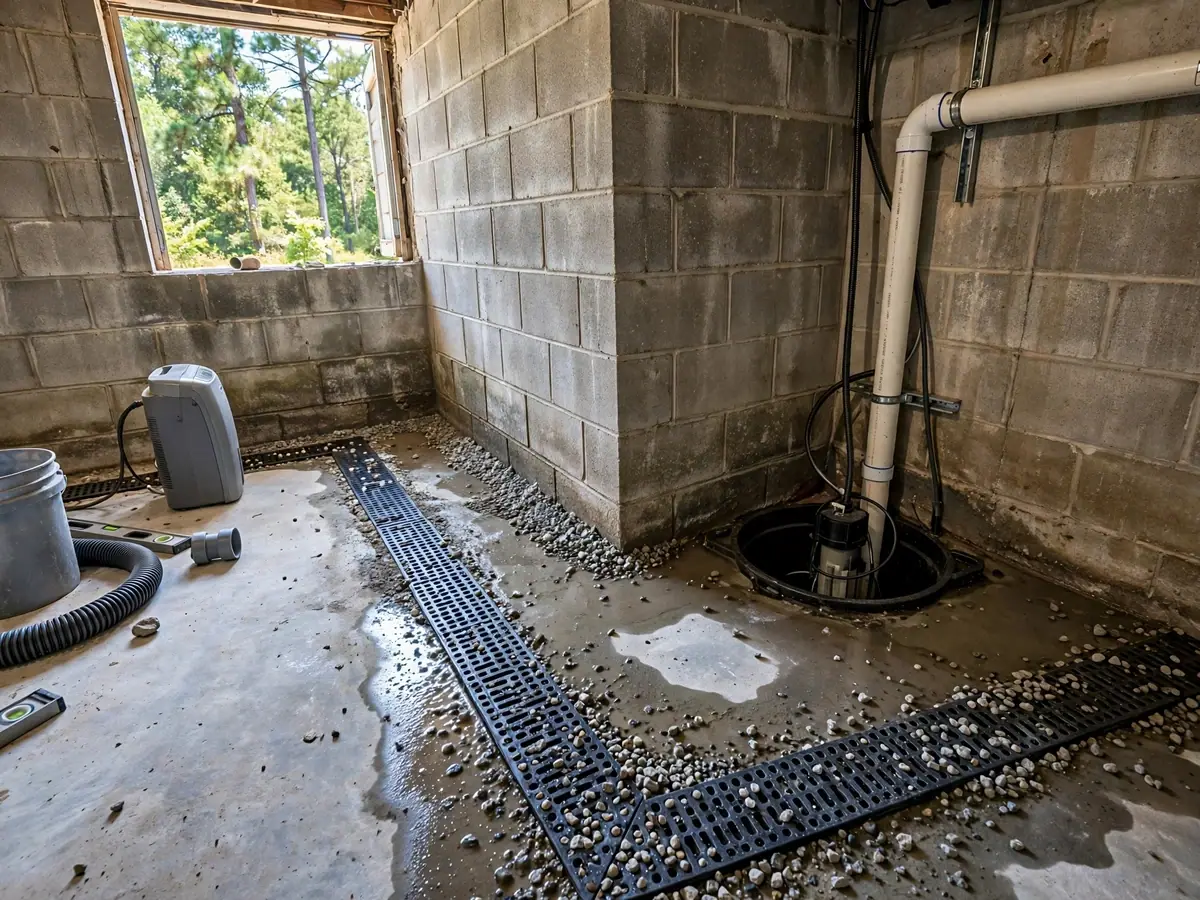
A basement waterproofing system is not one product. It is a set of parts that capture water, move it to a pit, pump it out and keep the basement air dry. Understanding the parts helps you read a quote and tell a complete system from a partial fix.
This guide describes each part, the order in which the work is done, and what is not part of the system. For the general approach, see our basement waterproofing page.
The parts of an interior system
| Part | What it does | Notes |
|---|---|---|
| Perimeter drain | Collects water at the floor-wall joint | Perforated pipe in gravel under the slab edge |
| Wall drainage membrane | Channels water running down the wall into the drain | Used on walls that seep |
| Sump pit and liner | Collects the water from the drain | Sized for the expected inflow |
| Sump pump | Moves the water out of the house | Battery backup recommended |
| Discharge line | Carries water away from the foundation | Check valve prevents backflow |
| Vapor control and dehumidifier | Keeps basement air dry | Supports the system, not a substitute |
Want a plumber to look at your waterproofing system problem? A real dispatcher answers 24/7.
Call (339) 216-9771The sequence of the work
The order matters, because a perimeter drain without a pump just moves water around, and a pump without a drain only works on the water that reaches the pit.
- Diagnose where the water enters, and fix outside sources such as gutters and grading first.
- Cut a trench along the interior perimeter and remove the concrete.
- Lay the drain pipe in gravel with a slight slope toward the pit.
- Install the sump pit and liner at the low point.
- Patch the trench with new concrete and install the wall membrane where needed.
- Set the pump and discharge line, test with water and add the backup.
Outside work still matters
An interior system manages water that reaches the foundation. Reducing that water in the first place is cheaper and makes the system's job easier. Gutters that are clean, downspouts that discharge several feet away and soil that slopes away from the house all help.
In some cases, exterior excavation and drainage are the right answer, but it is a much larger project. A good contractor explains why one approach fits your house better than the other.
Cracks, joints and wall sealing
A crack that leaks can be injected with epoxy or polyurethane to stop the entry. Sealing a crack makes sense if the crack is stable and the cause is understood. It is not a substitute for a drain when groundwater pressure is the issue.
Wall coatings can help with dampness but are not designed to resist water pressure. If a quote consists only of paint, ask what it promises and for how long.
What the system does not do
Read each quote for what is in and out. A system with no backup, or one that skips the discharge line, is a partial system. Our sump pump page explains the pump and backup choices.
- It does not lower the water table.
- It does not fix a failed gutter system.
- It does not replace a dehumidifier in a humid space.
- It does not repair a cracked or settling foundation.
- It does not protect a basement from a power failure unless a backup pump is included.
Reading a waterproofing quote
A good quote names each part of the system, the length of drain in feet, the pump model and horsepower, the discharge route and the warranty terms. A quote that says only waterproofing system with a single price should be broken down before you sign.
Ask whether the quote includes a battery backup, a sealed pit lid, wall membrane where the walls seep and patching of the concrete trench. Ask who holds the warranty, how long it lasts and whether it transfers when you sell the house. And ask what happens if water still enters, since a system that comes with a clear remedy shows the contractor stands behind it. If a quote cannot answer those questions, keep looking.
It also helps to ask how the contractor will protect finished space during the work. Cutting a trench in a slab makes dust, and a good crew seals the work area and cleans up each day. Ask for the schedule in writing and for a named point of contact on the job, so you know who to call if something looks wrong.
Stoneham conditions to plan around
Stoneham sits near Spot Pond and the Middlesex Fells, and some parts of town are lower and wetter than others. Basements near wetlands or on lower ground can see higher groundwater in spring, which is when a system is tested most.
Ask Stoneham Public Works or the Building Division about discharge rules before you plan the sump discharge, since connecting a sump to the sewer is generally not allowed. Homes in nearby Winchester and Melrose should confirm their own town's rules.
Want a local plumber to check your waterproofing system? Call now.
Call (339) 216-9771Frequently asked questions
The drain collects water at the floor edge, and the pump moves it out of the house. They work together.
If an outage during a storm would leave the basement at risk, yes. The backup runs the pump for hours without power.
Interior systems are less disruptive and common for existing homes. Exterior work is bigger and used where it is justified.
A typical interior perimeter system takes a few days, depending on the length of the walls.
Yes, once it has been dry through a wet season. Use moisture-resistant materials and keep the pump accessible.
Questions about waterproofing system in your own house? Call and describe what you see.
Call (339) 216-9771