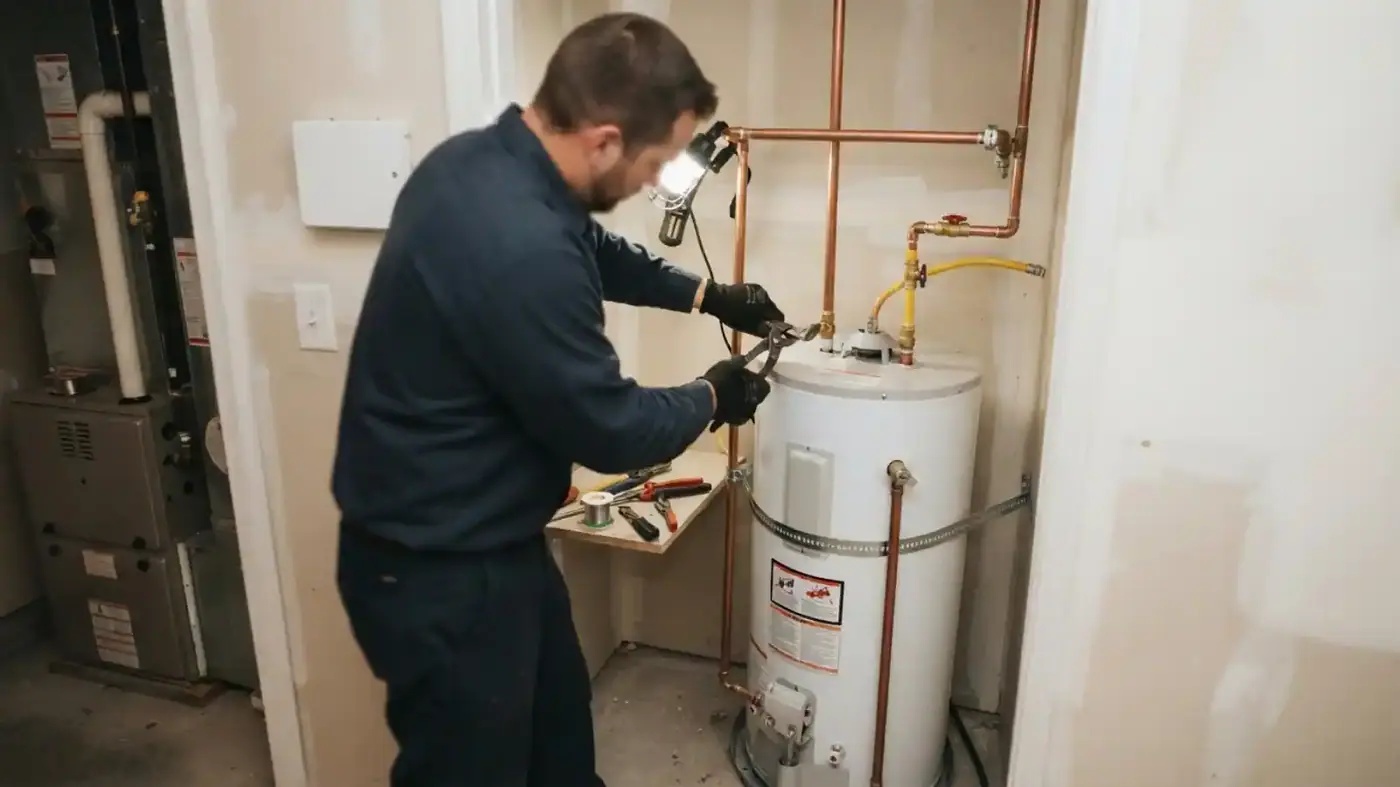
Emergency water heater repair in Stoneham, MA starts with a simple question: is the tank leaking, or is it just not heating? A heater that is cold but dry usually has a failed part such as a thermostat, heating element, thermocouple or gas valve, and those are repairable. A tank that is leaking from its body is usually finished.
This page walks through the common faults, what each one costs in time and parts, and how to decide between repairing the unit you have and replacing it with a new one. If water is on the floor right now, start with the urgent section below.
Water heater leaking or no hot water: first steps
A leaking tank can drop dozens of gallons onto a basement floor in an hour, so shut it off before anything else. Our 24/7 line is open on weekends and holidays, and a dispatcher can talk you through the shutoffs.
Work through these steps in order.
- Turn off the cold water supply valve on the pipe above the heater by turning the handle a quarter turn or the wheel clockwise.
- For an electric heater, switch off its breaker. For gas, turn the gas control knob to off or pilot.
- If water is spreading, open a hot tap upstairs to relieve pressure, and use a hose on the tank drain valve to carry water to a floor drain.
- Move stored items off the floor, and take photos for your insurer.
- If you smell gas, leave the house and call the gas utility from outside. Do not turn lights or switches on or off.
Dealing with water heater repair in Stoneham? A real dispatcher answers, day or night.
Call (339) 216-9771Common water heater faults and what fixes them
Most no-hot-water calls come down to a short list of parts. The plumber tests power or gas supply first, then the controls, then the part that makes heat.
| Symptom | Likely cause | Typical repair |
|---|---|---|
| No hot water, electric tank | Tripped high-limit, failed element or thermostat | Reset or replace the element or thermostat |
| No hot water, gas tank | Pilot out, bad thermocouple or gas control valve | Relight and replace the thermocouple or valve |
| Water is lukewarm | One of two elements failed, or sediment on the burner | Replace the element, flush the tank |
| Rumbling or popping noises | Sediment hardened on the bottom of the tank | Flush, and consider replacement if the tank is old |
| Water drips from the relief valve | High pressure or temperature, or a worn valve | Replace the valve, test pressure, check the expansion tank |
| Water at the base of the tank | Failed tank, loose fitting or drain valve | Tighten or replace a fitting, replace the tank if it is the body |
Repair or replace: how the decision is made
A tank water heater typically lasts around 8 to 12 years, and the date of manufacture is on the data plate near the top. If the unit is within a few years of that range and needs a major part, a replacement often makes more sense than a repair.
A rusty puddle under a tank, or rust-colored hot water only, points to corrosion inside. That cannot be repaired. For a unit younger than that with a bad part, repair is usually the better value. Our water heater replacement page covers the next step if the tank is done.
Safety checks that come with every repair
A water heater holds scalding water under pressure, so safety parts matter as much as heat. The temperature and pressure relief valve must be present, and its discharge pipe should run down toward the floor with no cap or threads on the end.
On gas units, we check the vent and draft so exhaust leaves the house. If a carbon monoxide detector sounds, leave the house and call 911. Do not wait for a plumber.
- Relief valve present with a full-size discharge pipe
- Gas shutoff valve within reach and no smell of gas
- Venting intact, no rust stains or soot at the draft hood
- Expansion tank in place when the house has a check valve or pressure reducing valve
- Water temperature set to a safe level, commonly 120 degrees
Stoneham water and your heater
Stoneham's water comes from the MWRA system, and the MWRA describes it as soft, at about 1 grain per gallon. Soft water causes less scale than hard water, so sediment in Stoneham tanks tends to build slowly and comes more from age than from mineral scale.
That does not make flushing pointless. Draining a few gallons from the drain valve once a year carries off what has collected and lets the plumber see how the tank is aging. Anode rods, the sacrificial metal inside the tank, still wear out and are worth checking at the same visit.
Gas, electric, oil and tankless: we repair most types
We service gas and electric tank units and look at tankless units that have lost hot water or show an error code. See tankless water heater service for descaling and parts. For an oil-fired boiler with a coil, call us, and the dispatcher will tell you whether a plumber or a heating technician is the right visit.
If you have a sealed combustion or power-vent unit, tell the dispatcher when you call. Those units have fans and sensors, and a short list of faults tells us what to bring.
What affects the price of water heater repair
Which part failed
A thermostat or element is a short job. A gas control valve or a tank fitting takes more parts and time.
Fuel type
Gas units need combustion and venting checks in addition to the water side.
Age of the unit
An older tank may be near the end of its life, so a repair may not be the best use of money.
Access
A heater in a tight closet or a finished utility room takes longer to service than one in an open basement.
Time of day
Night and weekend dispatch is available 24/7, with the price given before the work begins.
Homeowner insurance often covers water damage from a sudden tank failure but may not pay for the heater itself. Photograph the label and the damage before you move anything.
Water heater work, including relief valves and gas connections, is regulated under 248 CMR, and the relief valve requirement comes from the plumbing code.
Want your real number? Call (339) 216-9771 and describe the problem. You get a clear price before work starts.
Frequently asked questions
Yes. Our 24/7 line takes water heater calls at any hour. A dispatcher will tell you what to shut off and book the earliest visit available.
Look for where the water starts. A drip from a pipe connection, the relief valve or the drain valve can be repaired. Water coming from the metal body of the tank, or a rusty seam, means the tank has failed.
On an electric heater, check the breaker and the reset button on the thermostat. On gas, check whether the pilot is lit. If neither fix works, a part such as an element, thermocouple or gas valve has failed.
Tank models commonly last 8 to 12 years, depending on use and maintenance. The date of manufacture is printed on the data plate.
No. A leaking tank can fail suddenly and flood the area. Shut off the water and power or gas to it, and call a plumber.
Ready to talk through your water heater repair problem? Call the 24/7 line.
Call (339) 216-9771