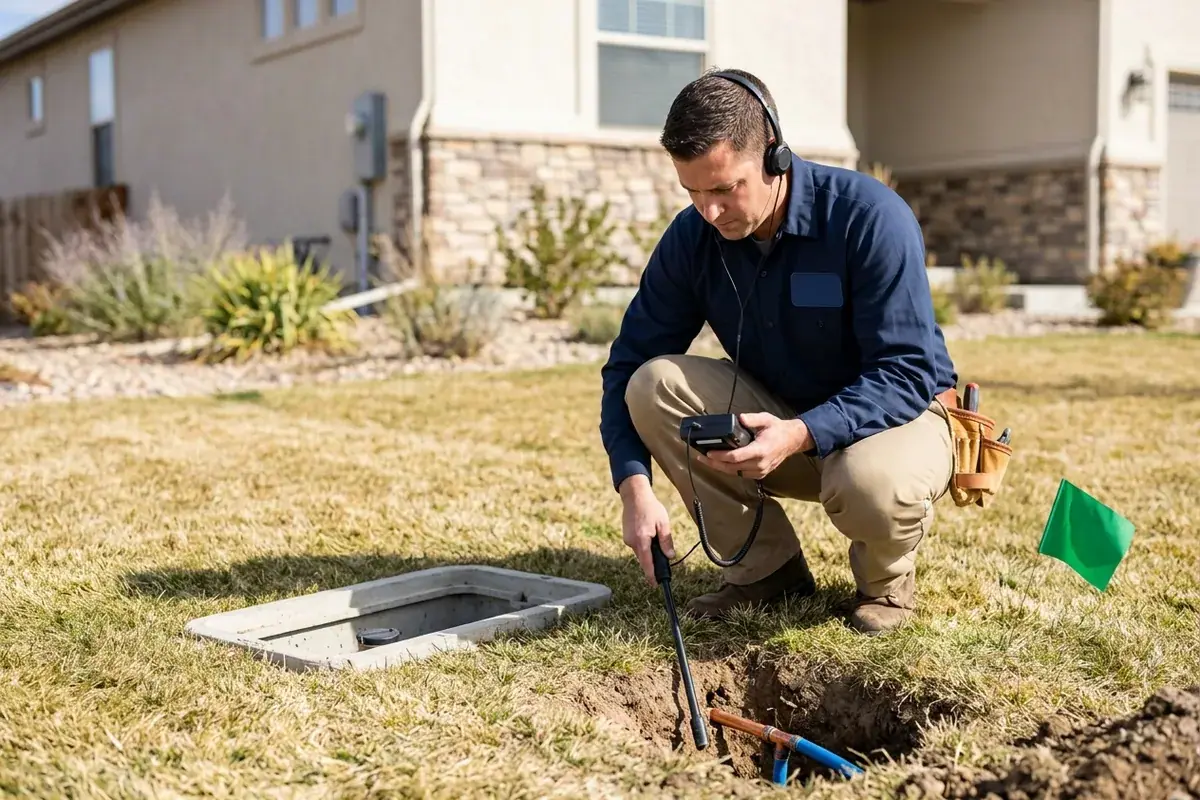
An irrigation system is a set of pipes, valves and heads buried a few inches under the lawn, and a break in any part can waste hundreds of gallons a day without any visible spray. The signs are a soggy patch, a lawn that is greener in a stripe, or a water bill that rose for no reason.
This guide shows how to confirm whether the leak is in the sprinkler system, how to narrow it to a zone, and what a plumber can do. For leaks in the house or on the service line, see our leak detection page.
Signs of a sprinkler leak
Any of these can have another cause, so the meter test comes first.
- A wet or spongy spot on the lawn when the system has not run.
- A head that sprays weakly or at an odd angle.
- Pressure that drops when one zone runs.
- A water meter that moves when all fixtures are off and the system is idle.
- A water bill that rose in the watering season beyond what you expected.
Want a plumber to look at your sprinkler leak detection problem? A real dispatcher answers 24/7.
Call (339) 216-9771The meter test, step by step
- Turn off all water use in the house, including the ice maker and the dishwasher.
- Make sure the sprinkler controller is idle and no zone is running.
- Read the water meter and note the leak indicator, a small triangle or dial that spins with any flow.
- Wait 15 minutes without using water, and read it again.
- If it moved, water is leaking somewhere. Close the irrigation supply valve and repeat. If the meter stops, the leak is in the irrigation system.
Finding the zone
Once the irrigation is confirmed as the source, run one zone at a time while watching the meter and the lawn. The zone that shows pressure loss, geysers or pooling water has the leak. Check each head for cracks, missing parts and a head that has been struck by a mower.
Valves are a common culprit. A zone valve that does not close fully will leak into its zone for hours, leaving a permanently soggy head. The valve box, a green or black lid in the lawn, is where to look.
| Symptom | Likely cause | Fix |
|---|---|---|
| Geyser at a head | Broken or hit head | Replace the head |
| Soggy patch between heads | Broken lateral pipe | Dig and repair the pipe |
| Zone leaks when off | Valve diaphragm worn or debris | Clean or replace the valve |
| Water in a valve box | Fitting or valve leak | Repair the fitting |
| Low pressure at one zone | Leak or a clogged head | Locate and repair |
Winterization and why it matters in Massachusetts
Water left in irrigation pipes freezes and splits them, and the damage shows up in spring as geysers and soggy patches. Systems in New England are blown out with compressed air in fall, which clears water from the lines. A system that was not winterized properly often has several breaks.
If you think this happened to yours, do not turn the system on and let it run. Shut the irrigation supply and call us. A leak under a lawn near the foundation can also reach a basement wall.
What a plumber adds
A plumber can test the pressure on the irrigation line, locate a break by sound when the lawn gives no clue, and repair the connection at the house, including the backflow preventer that protects the drinking water. Some towns require backflow devices to be tested on a schedule.
For a leak that is on the main service line before the irrigation tap, our water line repair page explains the process.
Repairing what you find
Most sprinkler leaks are inexpensive to fix once found. A broken head is a replacement part and a few minutes of digging. A cracked lateral pipe is cut out and joined with a coupling. A weeping valve gets a new diaphragm or a new valve. The cost is in the search, which is why the meter test and the zone-by-zone check are worth doing first.
After the repair, run the zone and watch the meter, then run the whole system and check each head for coverage. Mark the repair location on a sketch of the yard so the next person does not have to guess. If the system is more than fifteen or twenty years old and leaks in several places, a larger rebuild may be cheaper than repeated repairs, and an irrigation contractor can quote it.
Irrigation, the meter and Stoneham Public Works
Stoneham Public Works runs the town's water system, and it reads and replaces residential water meters on a regular cycle. Your meter's leak indicator is the tool for the test above. If the reading looks off or the meter itself seems damaged, ask Public Works to check it before you assume a leak.
Rules for irrigation backflow devices and watering restrictions can vary by town and by season, so ask your water department. Homeowners in nearby Reading and Wakefield should contact their own offices.
Want a local plumber to check your sprinkler leak detection? Call now.
Call (339) 216-9771Frequently asked questions
Do the meter test with the irrigation supply on and then off. If the meter stops when the irrigation is shut, the leak is in the irrigation system.
Yes. A broken lateral can lose hundreds of gallons a day, and it adds up across a billing period.
We find and repair leaks in the plumbing side, including connections, valves and backflow devices. For full system design and heads, a landscape irrigation contractor may be a better fit, and we will say so.
Yes. Close the irrigation supply valve and do not run the system until the leak is found.
Split pipes and cracked heads from trapped water that froze. A proper blowout in fall prevents most of them.
Questions about sprinkler leak detection in your own house? Call and describe what you see.
Call (339) 216-9771