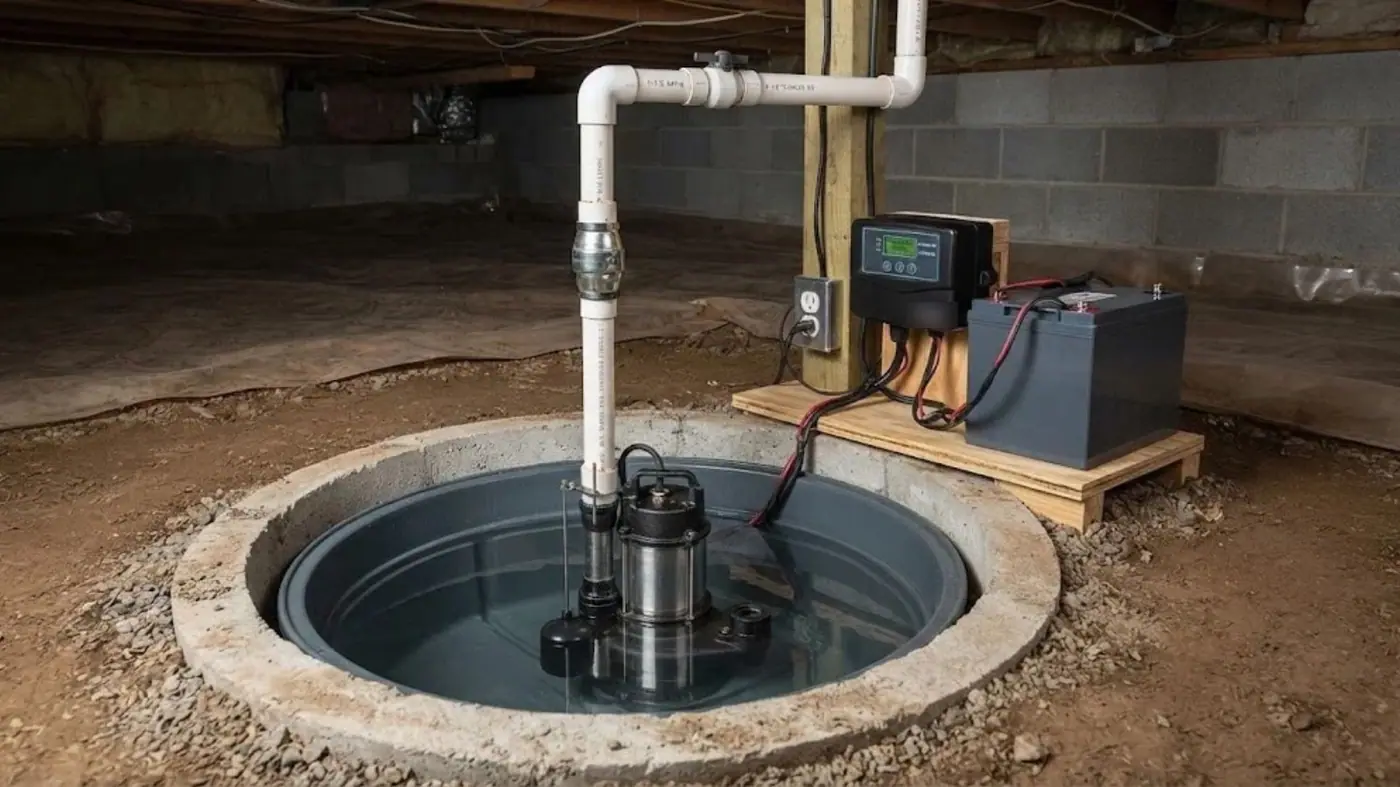
A sump pump installation has a reputation for being simple, and a replacement is. A new system, where no pit exists, is a bigger job that involves breaking concrete, setting a basin and running a discharge line outside. Knowing the steps helps you judge a quote.
This guide walks through the installation, how pumps are sized, the parts that are easy to skip and the choices between types. For the repair side and emergency calls, see our sump pump page.
Replacement or new installation
Replacing a pump in an existing pit takes about an hour or two. The plumber removes the old pump, checks the pit for debris, installs the new pump with a check valve and tests it with water. A new installation starts from nothing and takes longer.
| Job | Main steps | Time |
|---|---|---|
| Replace pump in existing pit | Remove, clean the pit, set the new pump and check valve, test | 1 to 2 hours |
| New pit and pump | Cut slab, dig pit, set basin, pump, discharge line, patch | Half a day to a day |
| Add a battery backup | Second pump or a backup unit, battery and charger | 1 to 3 hours |
| New discharge route | Drill the wall, run pipe, add an outlet | 2 to 4 hours |
Want a plumber to look at your sump pump installation problem? A real dispatcher answers 24/7.
Call (339) 216-9771New pit installation, step by step
- Pick the low point of the basement and the shortest route to the outside.
- Cut the slab with a saw and break out the concrete.
- Dig the pit to the depth of the basin and add gravel at the bottom.
- Set the basin level and fill around it, then patch the slab.
- Install the pump, the check valve and the discharge pipe, and run it to the outside.
- Test the pump with water and confirm the float works freely.
Pump size and type
Pumps are rated in horsepower and in gallons per hour at a given lift. A one-third horsepower pump suits many homes. A larger pump suits a basement with heavy inflow or a high discharge. A pump that is too small runs constantly and wears out. One that is too large short-cycles.
Submersible pumps sit in the pit and are quiet. Pedestal pumps have the motor above the pit and are easier to service but louder. Most installations use submersible pumps.
The parts that get skipped
A quote that lists only the pump is probably missing some of these. Ask what is included.
- A check valve on the discharge line, which stops water from flowing back into the pit.
- A sealed pit lid, which controls humidity and odors.
- A battery backup, which keeps the system working in an outage.
- A pipe that discharges far from the foundation, not at the wall.
- A frost-resistant outlet, which keeps the line from freezing shut in winter.
Maintenance after installation
Test the pump every few months by pouring water into the pit. Clean the pit once a year. Check the discharge outlet in winter for ice. Replace the pump every seven to ten years, or sooner if it runs often.
If your basement also takes in water through walls or the floor joint, a pump alone is not a full solution. Our basement waterproofing page explains the next step.
Sizing the pit and the discharge
The pit is the part most people do not think about. A pit that is too small makes the pump cycle on and off quickly, which wears out the switch and the motor. A pit around 18 inches across and 24 inches deep suits most homes, and a larger one gives the pump longer rests between cycles.
The discharge pipe should slope away from the house, and the outlet should sit several feet from the foundation, above grade, with a screen or a freeze-resistant fitting. A pipe that discharges at the wall can send water right back into the basement. In winter, a pipe that freezes shut turns the pump into a noisy fixture that moves no water, so plan an alternate relief path above the outlet where the layout allows.
Finally, plug the pump into its own outlet, not a shared extension cord, and use a ground fault outlet only if the code in your area calls for it, since a nuisance trip can silently switch the pump off. Test the pump after any electrical work in the basement, and again after any change to the discharge pipe, because a loose coupling can leak water straight back into the pit.
Discharge rules and permits in Stoneham
Stoneham Public Works says it works to reduce stormwater and groundwater getting into the town's sewer system, which is why a sump pump should discharge outside and not into the sewer. Ask Public Works or the Building Division what is allowed at your address.
Electrical work for a pump circuit may need a permit too. In nearby Reading and Wakefield, contact the local building office to confirm.
Want a local plumber to check your sump pump installation? Call now.
Call (339) 216-9771Frequently asked questions
A replacement takes one to two hours. A new pit and discharge line takes half a day to a day.
Outside, away from the foundation and neighbors. In most places a sump should not connect to the sanitary sewer.
If your basement would flood in an outage, yes. It adds a margin of safety.
Most homes use a one-third horsepower pump. Heavy inflow or high discharge may need more.
Every seven to ten years is common, or sooner if it is running constantly.
Questions about sump pump installation in your own house? Call and describe what you see.
Call (339) 216-9771