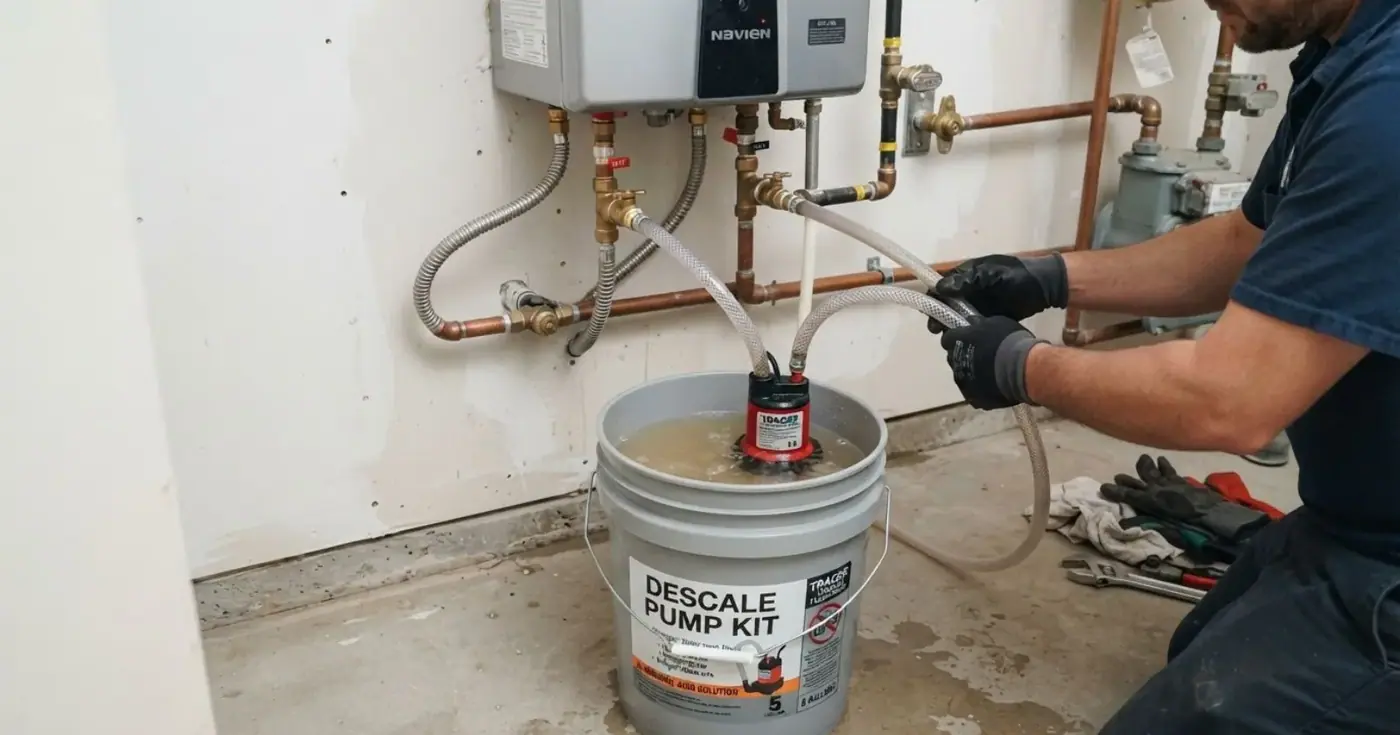
Tankless water heaters are marketed as instant, and the first shower after installation often disappoints. The heater itself responds in seconds, but the water still has to travel from the heater to your tap, and the cold water already sitting in the pipe has to be pushed out first. That is the wait.
This guide explains why it happens, how long the wait runs, and what a plumber can do to shorten it with recirculation or better layout. If you are weighing the whole project, see our tankless water heater page.
Where the delay really comes from
Three things add up. First, the cold water standing in the pipe between the heater and the tap. Second, the time the heater takes to detect flow and ignite. Third, a short cold sandwich, when brief hot water use leaves a gap of cold water before the next burst of heat.
| Delay | Cause | Fix |
|---|---|---|
| Long wait at far fixtures | Cold water in a long pipe run | Recirculation, shorter runs, smaller pipe |
| A cold gap between short draws | Heater has not restarted | Buffer tank, adjust usage |
| Weak flow trips the heater | Flow below the start threshold | Aerators, valve settings |
| Slow start in winter | Cold incoming water | Pre-warm via recirculation |
Want a plumber to look at your tankless instant hot water problem? A real dispatcher answers 24/7.
Call (339) 216-9771How long should the wait be
The wait depends on the distance and the pipe diameter. A rule of thumb is that each foot of three-quarter inch pipe holds about a third of a cup of water. A bathroom 50 feet from the heater has more cold water to flush than one 10 feet away.
A tank heater has the same issue. The difference is that a tank system is often judged against the slow wait it already had, and people expect tankless to remove it.
Recirculation: the usual cure
A recirculation system keeps hot water moving in a loop so it is near the tap. Some systems use a dedicated return line, and others use a crossover valve under the farthest sink that uses the cold line as a return. A pump, controlled by a timer or a button, circulates the water.
Many modern tankless units have recirculation built in or ready for it. The cost of heat loss in the loop is real, so a timer or a demand button saves energy compared with running all day.
- Dedicated return line: best performance, needs a pipe run to the heater.
- Crossover valve: uses the cold line, simpler to retrofit, can warm the cold water briefly.
- Demand button or motion sensor: the pump runs only when you want hot water.
- Timer: pump runs at set hours, for predictable mornings.
Layout and pipe choices that help
The best fix is to put the heater near the places that use the most hot water, or to run smaller pipe to the farthest fixtures. Insulating the hot pipe slows heat loss, so water stays warm between uses.
In a remodel or a new installation, plumbing installation can plan the pipe path with the heater in mind.
When tankless is the wrong fit
If you value instant hot water above all and have a long pipe run that cannot be changed, a recirculation system is a must. For a house with a small number of fixtures near the heater, tankless does well. For a house where hot water is used in small bursts, a tank with a recirculating loop can match its performance.
We help you weigh the options on a site visit, and we tell you if another system fits better.
Setting realistic expectations
Before you install a recirculation loop or move a heater, measure the problem. Time how long it takes the hot water to reach your farthest shower, and note the water that goes down the drain while you wait. That number tells you how much a fix is worth.
If the wait is ten or fifteen seconds, a small habit change may be enough. If it is a minute or more, recirculation is likely worth the cost. Whatever you choose, ask the installer for the expected wait after the change, and for the energy cost of running the loop. A plumber who has measured your layout can give you numbers, and one who has not can only guess.
Cold incoming water in a Stoneham winter
Stoneham's water comes through the MWRA system, and in January, the water entering a house is much colder than in summer. A tankless heater has to add more heat in winter to reach the same temperature, so flow limits matter most when it is cold. We size for the winter condition.
If you live in nearby Winchester or Wakefield, the same winter sizing rule applies.
Want a local plumber to check your tankless instant hot water? Call now.
Call (339) 216-9771Frequently asked questions
No. The heater responds in seconds, but the water still has to travel through the pipe. Recirculation shortens the wait.
It uses some, because hot water loses heat in the pipe. A timer or a demand button keeps the use low.
Yes, with a return line or a crossover valve. A plumber checks which suits the layout.
Short pauses can let the heater shut off, and it takes a moment to restart. A buffer or recirculation setup reduces it.
It can lower standby losses and last longer than a tank. The savings depend on use, fuel and the installation.
Questions about tankless instant hot water in your own house? Call and describe what you see.
Call (339) 216-9771