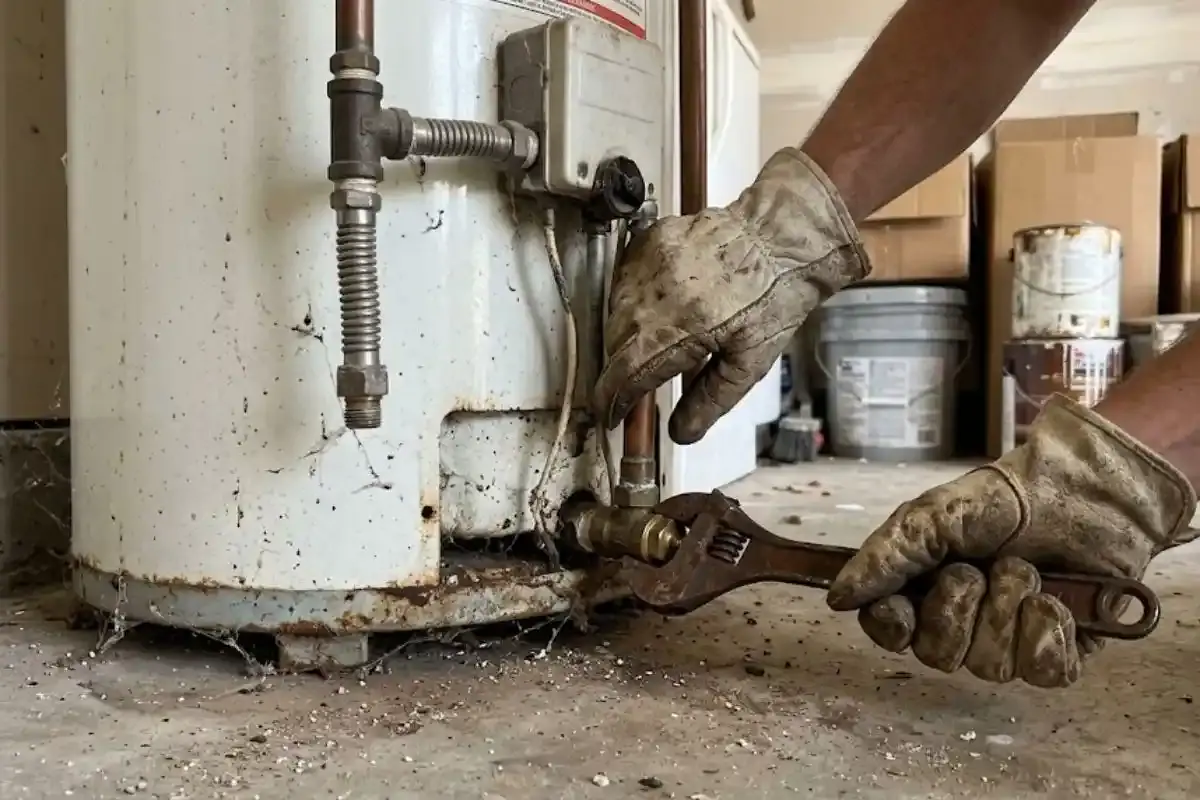
A water heater that leaks is either telling you a fitting has loosened or telling you the tank has failed, and the first job is working out which. The location of the water on the unit answers most of the question in under a minute.
This guide explains how to stop the water safely, where leaks usually start, which ones a plumber can repair, and how to decide whether to fix or replace. If you are in Woburn or Wakefield and the floor is already wet, our water heater repair page has the 24/7 line.
Step one: stop the water and the power
Do this before you try to diagnose anything. A tank can lose a lot of water in an hour, and the water near electrical equipment is a hazard.
- Close the cold water valve on the pipe above the tank. It is usually a lever or a wheel handle.
- For an electric unit, turn off its breaker. For gas, set the gas control to pilot or off.
- If the leak is heavy, attach a hose to the drain valve and run it to a floor drain.
- Open a hot tap upstairs so the tank does not form a vacuum while draining.
- Take photos of the leak, the unit and the data plate before you mop up.
Want a plumber to look at your water heater leak repair problem? A real dispatcher answers 24/7.
Call (339) 216-9771Where the leak is coming from
Dry the unit with a towel, then watch for the first drip. The location points to the cause.
| Where the water appears | Likely cause | Repairable? |
|---|---|---|
| Pipe connections on top | Loose or worn fitting, failed connector | Yes, tighten or replace |
| Relief valve or its pipe | High pressure, high temperature or a worn valve | Yes, but find the cause of the pressure |
| Drain valve at the bottom | Worn washer or a valve left partly open | Yes, replace the valve |
| Base of the tank, from beneath | Tank corroded through or condensation from a gas burner | Usually no, replace the tank |
| Along the tank seam or jacket | Internal tank failure | No, replace the tank |
Repairable leaks: fittings, valves and connectors
Most top-of-tank leaks come from the connections. A flexible connector that has aged or a fitting that was never fully tightened can drip for months. Replacing the connector and resealing the fitting is a short visit.
A dripping relief valve deserves attention beyond the drip. The valve opens when the pressure or temperature is too high, so a leak can mean the expansion tank has failed or the thermostat is set too high. Capping the valve is dangerous. See our repair page for the checks we run.
When a leak means the tank is finished
A tank is a steel vessel with a glass lining, and over the years the lining cracks and the steel rusts from inside. Once water seeps through the tank wall, no repair will hold. Rust streaks, puddles under the unit and a tank over ten years old all point that way.
If this is your case, the next step is water heater replacement. Ask about timing when you call, and ask that the old unit be hauled away.
Preventing the next leak
A water alarm costs little and gives you the earliest warning of a slow leak, often before any damage is visible.
- Install a drain pan with a drain line under any heater in finished space.
- Add a battery water alarm on the floor next to the unit.
- Flush a few gallons from the drain valve once a year.
- Check the anode rod every few years, and replace it when it is mostly consumed.
- Look at the base of the tank each time you pass it, and photograph the data plate for the date.
What the repair visit looks like
When a plumber arrives for a leaking heater, the first ten minutes are diagnosis. They dry the unit, run the water and watch for the first drip, then check the relief valve, the connectors, the drain valve and the base. A pressure gauge on a hose bib tells them whether the house pressure is high enough to stress the tank and the relief valve.
If the fault is a fitting, the repair is done on the spot, and the plumber turns the water back on slowly and watches the joint for a few minutes. If the tank itself is leaking, you get a clear price for a replacement before anything is removed. Either way, you should leave the visit knowing what failed and why, and with a note of the tank's age and the date of the work for your records.
Water heaters and Stoneham water
Stoneham's water comes from the MWRA system, which describes its water as soft, at about 1 grain per gallon. Soft water means less mineral scale on heating elements and in tanks. In practice, a Stoneham tank is more likely to fail from age and internal corrosion than from scale, so the date on the data plate is the best predictor.
For permits on a replacement, ask the Stoneham Building Division, which handles plumbing and gas permits. If you live in nearby Melrose or Winchester, the same advice applies, and you can confirm with your own town's building office.
Want a local plumber to check your water heater leak repair? Call now.
Call (339) 216-9771Frequently asked questions
Yes if the water is steady or the tank is leaking from the body. Shut off the water and power, and call a plumber. A slow drip at a fitting is less urgent but should still be fixed soon.
We suggest not. A leak from the tank body can get worse suddenly, and water near the electrical or gas controls is a hazard.
Many policies cover sudden water damage but not the cost of the heater itself. Photograph everything and ask your agent before cleanup.
Rust-colored water at the base usually means the tank has corroded through. The tank is finished and needs replacement.
Look on the cold water pipe above the tank, and for the main valve near where the water line enters the house, commonly in the basement near the meter.
Questions about water heater leak repair in your own house? Call and describe what you see.
Call (339) 216-9771