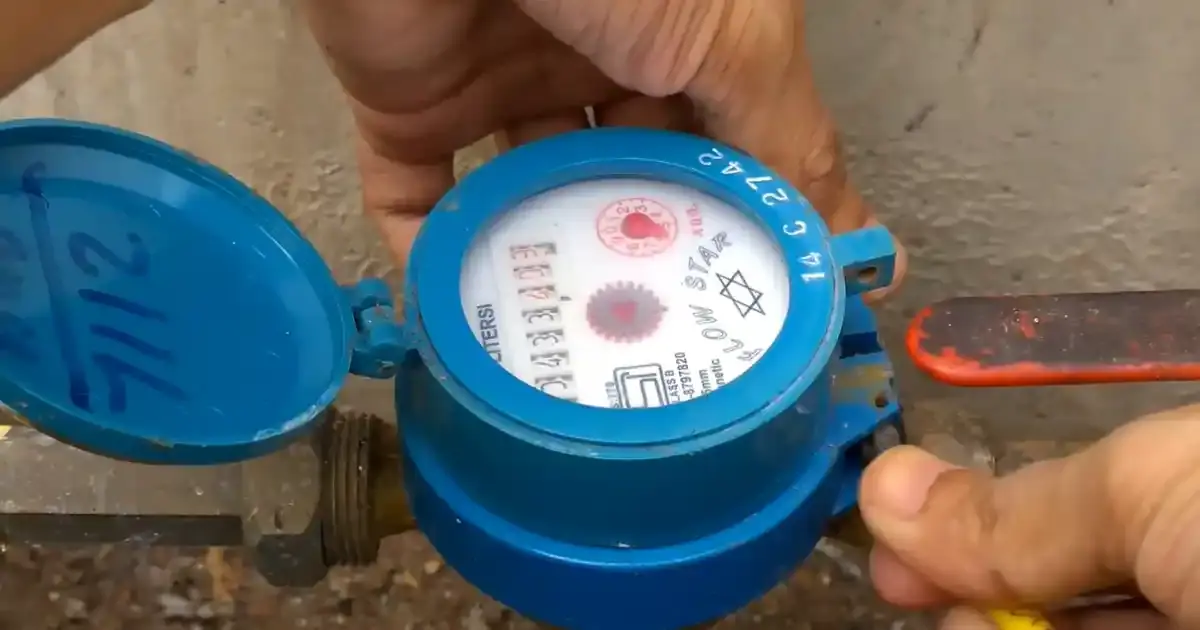
A hidden leak can run for weeks before it shows up as a stain or a bill. The water meter is the cheapest leak detector you own, because it measures every drop that enters the house. If it moves when nothing is on, water is going somewhere.
This guide shows how to find and read your meter, run a simple test and work out what the result means. If the test points to a leak, our leak detection page explains how a plumber locates it.
Finding and reading the meter
The meter is usually in the basement near where the water line enters, or in a pit outside near the street. It has a face with a row of numbers like an odometer, a sweep hand and a small leak indicator, often a triangle or a star, that spins with any flow.
Some meters have a radio transmitter, and the display may be a small digital screen. The numbers record usage in gallons or cubic feet, and the label tells you which unit your meter uses.
| Part of the meter | What it shows |
|---|---|
| Odometer numbers | Total water used since installed |
| Sweep hand | Flow in the moment, one turn equals a set volume |
| Leak indicator | Spins or flashes with even tiny flow |
| Unit label | Gallons or cubic feet |
| Serial number | Identifies the meter to the utility |
Want a plumber to look at your read your water meter problem? A real dispatcher answers 24/7.
Call (339) 216-9771The 15-minute leak test
If the reading has not changed, you have no significant leak at that moment. If the number moved, water is escaping.
- Turn off every faucet and appliance that uses water, including the ice maker.
- Check that no toilet is running, and that the irrigation system is idle.
- Look at the leak indicator. If it is moving, you already have your answer.
- Write down the odometer reading, or take a photo.
- Wait 15 minutes without using any water, and read it again.
Narrowing down where the leak is
Close the main shutoff valve in the house and look at the meter again. If it still moves, the leak is between the meter and the shutoff, which is the service line. If it stops, the leak is inside the house. Then close individual shutoffs one at a time, at the toilets and the water heater, to see which one stops the meter.
A running toilet is the most common cause. Try the food coloring test in the tank. If the meter moves slowly, a toilet flapper is the likely culprit. See our guide on toilet repair for parts.
Slab, wall and underground leaks
A leak that survives all the individual shutoffs and does not show on the surface is in a wall, a slab or underground. Signs include warm spots on a floor, the sound of running water and a damp patch in the yard. These need listening equipment and thermal imaging.
If the service line is the problem, water line repair explains how it is found and fixed. Do not dig yourself, because gas and electric lines may be nearby.
When the meter is not the answer
A rise in a bill is not always a leak. Seasonal use, guests, irrigation and billing estimates all matter. If the 15-minute test shows no movement and the bill is still high, ask your water utility to read the meter and check its accuracy.
A meter that is damaged or very old can read wrong. Public utilities replace meters on a cycle, so a utility visit is the right step if the meter itself looks suspect.
Keeping a record of your readings
Once you know how to read your meter, write down the reading at the same time each month. A simple log shows how much water your household uses in a normal month, so a jump stands out right away instead of arriving as a surprise on the bill.
Also note your reading before and after a trip. If you go away for a week with every fixture off and the meter moves, you have caught a leak with no guesswork. And if the number rises in a pattern, for example only overnight, the pattern points to the source, such as a toilet that refills in the small hours or an irrigation timer that fires at night. Small habits like this save real money.
Stoneham Public Works and your meter
Stoneham Public Works says it replaces water meters on a 15-year cycle and reads them quarterly and monthly. If your meter is older than that, or you see damage, a call to Public Works is the right first step. Public Works can confirm the reading and check the meter's accuracy.
If the meter is fine and still moving with everything off, call a plumber. Homeowners in nearby Wakefield and Reading should ask their own water departments how meters are read and replaced.
Want a local plumber to check your read your water meter? Call now.
Call (339) 216-9771Frequently asked questions
Turn off all water and watch the leak indicator or the sweep hand. If it moves, water is flowing.
Often in the basement near where the water line enters. Some are in an outdoor pit near the street.
A slow movement can mean a small leak such as a running toilet. Test toilets first.
Call Stoneham Public Works, which handles meter reading and replacement.
Often yes. Listening gear and thermal imaging locate many leaks before any digging starts.
Questions about read your water meter in your own house? Call and describe what you see.
Call (339) 216-9771